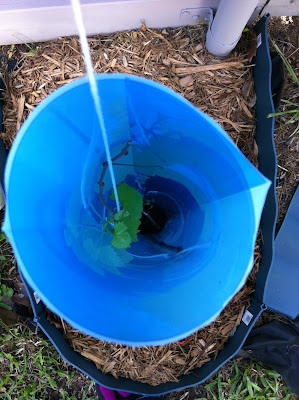
Looks like all that RnR (rinse and repeat) worry is doing something besides prematurely aging my face...
Behold, tiny grape life... Full of my future grapefriend's DNA and ready to brave the journey from twine to trellis:
And again, peeking out of the crazy witchcraft blue shelter that I put up against my better scientific judgment in the hopes that they get a better shot:
The party is on, but I still have plenty of RnR worrying to do, these two are relying on the still-dormant plants to pollinate. And if I can't summon some action from the nearby vines, these girls will grow old together, curly haired spinsters who lean on the fence all day and gossip.
Let's just hope the gentlemen-lover plants get the nerve to sprout and ask these ladies to tangle on the vine, so to speak...
Love,
Your Fairy Grapemother
Thursday, April 7, 2011
Friday, April 1, 2011
It's a Process, Right?
I'm not quite at the point where I do the same thing over and expect different results... quite.
But lately I've been investing a lot of soul in cooking, looking for the taste that I know I'm capable of creating. I just know I am. First, the risotto, I just didn't have the endurance to see the dish through AND eat it. Now, I'm conquered by a butter masala, well... to be honest, a butter masala and chapati.
I love Indian food. I love all kinds of Indian, but my favorite is Indian junk food, like you'd find in a curry shop in the UK. Today, I tried to make a tikka masala - which is the least Indian dish on those menus. But my craving stems from a different kind of kitchen failure. I had the rare chance to take some friends out for Indian food and it was by far the worst curry I've ever had. They were ill, I was embarrassed, and now I'm vowing to make something entry level so I can redeem myself and prove that Indian is yummy and safe to eat.
So I tried...
With no tofu or panir (and obviously no meat) I settled on potatoes for the star of my curry. I simmered my spices and tomatoes with the potatoes and set to work on chapati bread to go along with the gravy I was anticipating. With no yeast, I chose an unleavened bread to try out my skills. I rolled up a plain dough and let it rest while I did something I DO know a little about - rice. Lately I've been testing techniques with my rice cooker and basmati rice and have found the perfect recipe for the rice I have and the cooker we own. First, rinse the rice several times in clean water. Then, turn on the rice cooker and heat a little oil in the cooker pan. Finally, toast the rice for a few minutes to burn off the water from rinsing and make sure that all the grains get a coat of oil for their bath. Then add the water, lid it up, and walk away. The result? Perfectly separated fluffy grains of rice that look more like vermicelli than plain ol' rice...
But I digress, we're talking about failure here, not perfection. So with the rice cooking I set to rolling out the chapatis for the griddle. After making a righteous mess, and sticking dough all over my rolling pin, I finally figured out that like pizza dough - I needed to work the gluten and not protect it like my southern biscuit instincts tell me.
I rolled them up and Bart started grilling.
Just like pancakes, it took until the last couple to get the technique right. They still taste a little doughy and dried out really fast. Next time I'll man up and use some yeast and make naan instead.
All in all, the meal wasn't a total failure, but the masala left me wanting less yogurt and more tomato. I'm sure I was missing the familiar taste of preservatives too. The potatoes cooked perfectly and the sauce consistency was right. The color wasn't too far off, either. But the end result was too tangy or sour and Bart didn't eat much. I'll be back, masala... you can't scare me off that easily. I cook to win.
Now I have to go, Bart wants me to pay attention to him instead of my food for a little while.
Thursday, March 31, 2011
Secretly
I'd make a terrible special agent. I have scars, tattoos, secrets, and plenty of "tells" when I lie. But there are some reasons why I would fit in. I change my haircolor drastically at least every 6 weeks. My ocd allows me to pick out extraordinary or abnormal things. I firmly deny occam's razor, because more often than not, the difficult complicated solution is right too. I like to travel. I value adventure. I party.
But alas, I'll never be a secret agent, or secret anything.
Me, my body, and my intellect will have to find more domestic affairs toward which I'll focus my attention and superpowers.
But alas, I'll never be a secret agent, or secret anything.
Me, my body, and my intellect will have to find more domestic affairs toward which I'll focus my attention and superpowers.
Friday, March 25, 2011
Hospital-Able
I am comforted by disinfectant.
I have always been more at home in a clinical environment than in the real world. In the hospital, everything makes sense. People either get better or worse. They either heal or they don't. There is no middle... no grey.
As a child, my father worked at the hospital. On rare occasions I would visit him. He showed me exciting ways that he helped people feel better, and mysterious places that I didn't know even existed... like the NICU, and underground tunnels.
It's true that as a child, dad gave me medical terminology books to read. At the age of 10 or 11 I was making words out of latin roots. I loved the terminology because the system was just that - orderly and predictable. An infection meant -itis, a growth meant - oma, a study - an 'ology. I valued this order when nothing else made sense. I was a smart kid who never fit in, my family was different, and all I knew was I wasn't like anyone else.
Along with medical terminology, I studied other systems. The phone book and dictionary were frequent members of my personal library. I would read anything really, if it gave me a chance to look for another pattern.
A waif, I never got into sports. I couldn't even run a mile without thinking I would surely die or vomit in public (equal embarrassment). I learned to enjoy activities that kept me isolated, like music and writing. Somewhere around the age of 14, when I got mononucleosis, I realized maybe I wasn't just weak and got sick more than other kids.
Of course I wanted to know why. It's hard to believe, even for me, but back then I had no internet to search for the cause of my illness. A nice doctor, who I really liked, called it Epstein-Barr Virus then, a consequence of the mono. In any case, it started a sequence of events that would bring me closer to medicine. Healthcare, like the hospital, seemed orderly. There was a science to every action. A drug prescribed for a condition, a cause and effect.
As I grew older, I felt more and more at home in this clinical setting. The order calmed me. Problems were always solved. Effects always caused, reason always consulted. I remember the first time I saw a dead body, my aunt, and touched her face... she was cold, waxy, but I wasn't afraid, I was comforted by the familiar clinical setting. Someone tried to solve this problem, but couldn't.
Maybe it's fitting that I am more at home in this clinical setting. Always uncomfortable with human interaction, I value the situation when gloves are required, and contact is avoided. I'm never scared by threatening situations in a hospital because a system is responsible instead of a few feeble humans. There are codes, procedures, ordinances that keep problems at bay.
So what kind of 'ology describes the study of the system that exists in institutions like hospitals? How can I dissect and analyze my comfort in this uncomfortable place? Why am I the family member anyone can count on to wait out a hospital stay with them... read them stories, do their laundry, sneak them food? Why am I unafraid to face mortality in this place? I'm not above the rules, and will someday likely die in a hospital, but I find that strangely comforting. The system, the institution, is built to shepherd us on in a strange, clinical, orderly manner.
And maybe that's it, the word clinical... I don't remember it from my med-term texts, but I'm sure it means to detach and objectively treat problems... and that's something I'm only able to do with a pair of gloves and a gown.
In any case, I prefer bleach to fresh-baked cookies. I remember everything I've ever heard in a hospital(and often nothing I hear on the phone). I put 'hospital corners' on the bed when I change the sheets, and I can inject my cat with anything without fear. I trust in the system. Healthcare, medicine, infection control, disease management, diagnostic screening, all of it makes sense.
If only I could have thanksgiving and christmas in a hospital operating room. No awkward hugging or uncomfortable small talk, we'd cut up the food and stay on schedule, and no one would get drunk and ruin the holiday.
And everything would be sterile.
Friday, March 18, 2011
RnR Worry About Grapes
OCD types know a thing or two about repetition... we belong to a league of hand-washers, door-lockers, and light-switch-on/off'ers. Rinse and repeat (R&R) is something that happens pretty often throughout the day.
Today's R&R - Worry about the grapes we planted last weekend. During the week I've done a few more prep steps, mulching, training, watering to make sure they get a good start. Just outside the window where I work most days, I can see one of the plants, and I swear it's telling me it's unhappy!
I put the blue grow tubes over the vines like the nursery said, and added soil acidifier and fertilizer.. I've been giving them plenty of water, but not too much. The sun finally came out today and gave them a wake-up, but I'm worried that all 6 of them won't put on growth. Two are already showing signs of life, with little buds of side growth popping out of the vine, but the other 4 are still dormant.
If I don't get the self-fertile varieties to grow at least, I won't have any grapes at all..
So I'm sending out mental energy and hoping to fertilize them with worry power. I thought about playing them music or getting them a friend - a dog might be too destructive but I could keep some pigeons? They would keep the vines company, and poop all over my yard too.
What if the spots I chose to plant them were not sunny enough, we'll have sad shady growth. Or maybe the holes don't drain because of the clay surrounding the amended dirt, their little grape feet will be wet and they'll suffocate. Of course I could have put the shelters on wrong and they aren't getting the right light or ventilation.
I read all the instructions and tried to do everything correctly... Now I just have to trust that nature, in combination with my nurturing will be enough for them to grow up. Until they get old enough to survive on their own, I'll just keep worrying.
This sounds like a sick allegory to child-rearing. I think if I were to have 6 children instead of 6 grapevines my head would implode with anxiety.
Are you all right in there? Are you sitting comfortably? This is your grape-godmother speaking, hello?
Thursday, March 17, 2011
The Pseudoscience of Toasted Tastebuds
Have you ever peeled back the glorious cheese layer on a french onion soup to uncover soup that is as hot as the surface of the sun? Or removed a pizza from the oven and been so excited and hungry that you took a bite only to instantly blister the roof of your mouth with nuclear sauce just beneath the cheese?
There are certain foods that get us every time, and while I'm sure actual scientists have some type of scale based on conductivity, density and water content for this phenomenon... I don't know about it, so Bart and I created our own scale. The HEAT RETENTION FACTOR or HRF scale. This scale describe the property a food has to retain heat after cooking, the ability to heat to temperatures that will burn your gingival tissues, and the stickiness of that food to said tissues (worsening the burn results).
Our love of frozen pizzas led us to discuss this problem many years ago and since we created the scale we have made a number of observations in HRF.
1. HRF is variable for each food depending on the preparation. Sometimes microwaving a food creates higher HRF than baking.
2. HRF differs for the same food item in different preparations. Marinara sauce baked in a ziti with no mozzarella cheese covering has less HRF than the cheesed version.
3. Certain foods are HRF multipliers, some exponentially. Because cheese traps steam below it in foods like pizza and french onion soup, it protects the extreme heat pocket, dramatically increasing HRF values.
4. The time component of HRF can be subjective. Some foods never reveal their potential HRF because they are cooled before eating or because they take longer to reach the table (like delivery pizza)
We base our rating on the following scale:
10 - most likely to cause serious burns on the tongue and roof of mouth: this rating is given to french onion soup for the extreme heat of the liquid, ability to retain large amounts of heat for a period of time, and stickiness of the cheese topping. The soup burns your tongue, the cheese takes the roof of the mouth. Plus it usually smells and looks so appetizing that consumers are unable to wait the 20 minutes it would take to cool.
5 - medium risk HRF foods: given the right circumstances, when eaten with haste will inflict burns on the eater. Foods like reheated mashed potatoes and cheese whiz belong near this rating.
1 - foods that lose heat at an alarming rate, pose no risk of burns and become less appetizing quickly after cooking: steamed asparagus and broccoli have the least HRF because they lose heat immediately after cooking and have no stickiness.
Why am I sharing my HRF scale with you? Because its so annoying to burn your mouth. Your tastebuds lose their ability to communicate the glorious food you're eating, it's painful, and if it blisters - impossible to stop yourself from running your tongue over the burn like a weird-tasting ocd tic. As I type, I'm licking my wounds - literally - from last night's pizza incident in which I tried a new oven configuration thanks to an article from the food lab over at Serious Eats. The pizza was cooked perfectly, but I prematurely bit (forgetting the HRF) and roasted my palate.
Other high-HRF foods that always need extra time to cool: steam-baked potatoes [HRF 8](wrapped in foil and baked or microwaved), baked macaroni and cheese [HRF 7] and microwaved soup [HRF 8+].
So if you do any cooking at home, which is where most HRF-related burns occur, consider potential HRF based on temperature, timing and stickiness before excitedly trying your dish. Your mouth will thank you.
Tuesday, March 15, 2011
The Private Prize
When I was a little girl, my grandmother used to tell me that rain was the tears of people who lived in heaven. She never had a good answer when I asked why they were so sad, but she regarded sadness as a part of living. I understand that more everyday.
I might have been surrounded by sadness as a child, but never knew it. My family did a good job of making hard times happy and leaving us wanting for little except maybe control over our finances. At a very prosperous time for my parents, perhaps before I was around, my mom bought a piece of art. This was a luxury even though she was a successful flight attendant and made a comfortable living. She spent the money on something that was purely for enjoyment and not at all practical - opposite of her way and a real indulgence.
I don't remember the day this piece first graced the wall of her bedroom, because it seems like my entire life it was there. The object of many aimless staring sessions, some studied fascination and a lot of mystery, this piece of art was the only one I'd ever seen... that was called 'Art'.
Sure, I'd seen paintings and prints.. I fancied myself an artist as a child, but nothing in the house, even cherished oil paintings of local Texas bluebonnets painted by friends, was called 'Art'. That is, except this piece. I'm sure I asked Mom at some point what made this framed wonder so special and why I couldn't stop staring at it, and I even remember some of that answer, but no one ever told me why it was so unique. Mom loved it. She would look at it a lot, and you could see her just jumping right in the frame with it, especially during the cold years when our family was less prosperous. It seemed to stand for something, something that she relied on to get her through hard times.
As it turns out, it certainly has value. It was made by a famous art deco artist known as Erte, one of his serigraphs. He's a celebrated artist and his works can be very expensive. This one, numbered and signed, I'm sure is worth some money, but it's not the monetary value that makes me want to have it and look at it now.
You see, my grandparents grew up in the depression, my parents were taught to appreciate money in their own way. My family was never achingly poor, but we felt the pinch more times than I care to recall. In those times, value of things and stuff was inflated by hope, those things - and especially this serigraph were assets of a family that had little and dreamed of plenty. I never knew then why I loved it so much. 'After the Rain' was just nice to look at, to stare for hours and explore. I imagined how it was made, what went through the artist's mind while conjuring the image, but most of all, why my mom liked it so much. I searched within the dots and layers to find what special part within made her happy.
Although it doesn't grace the same wall in her house, I can still recount many details. I've counted the raindrops in each column, carefully examined the face and its expression, appreciated the white space around the image... once opulent and wasteful, now I see that matting as a separation between what you see inside and what is the same around you. As it turns out, for me, what drew me to this piece was not what was embossed on the paper, but what was reflected from my life from within and without.
One might look at the image link and see a very sad person, surrounded by evidence of their pain, so much that the clouds had to weep along with the subject. When I was young and struggling financially or emotionally or socially my life was always better than what I saw in there. Nothing could be so sad that the real clouds would cry with me. Now, I see more of an equal reflection. Not sadness, just the line between it and happiness. Life has layers of bad and every once in a while, they all align like a serigraph to create a hell of a rainstorm. Things in your control like your own tears may stop, but you can't censor rain, or the clouds that come along.
The similarities look to the sky as well. Many times I have looked out the window of an airplane, as I imagine mom did, and have glimpsed clouds as two-dimensional. You only suffer their precipitaion or darkness while you are below, but when you climb above, a more sunny and beautiful side of them appears.
I'm sure there are many reasons to relate to art, especially Erte's pieces. I see balance there, enjoying relative happiness in a glass-half-full glow, and seeing reality for its more sinister beauty. Sometimes rain, tears, darkness and light, and hope all collide in front of you. If you're listening, you can behold a moment of clarity and this visage will be valuable... Not in dollars, necessarily, but in peering through the obvious to see the clandestine pieces of yourself reflected back.
It makes you want to share, to use your own vision to understand, to explain... but it is only yours. I'm the only person who sees this serigraph exactly this way, but I'm not the only one who sees it. For mom, the paper reflects something completely different, but no less significant.
Either way, it's beautiful.
Image courtesy of gallerydirectart.com.
Subscribe to:
Posts (Atom)